Table of Contents
Stillness Changes Everything
For many of us across the Asia-Pacific region, the pace of daily life has never felt more relentless. Deadlines stack upon deadlines, notifications arrive before the last ones are read, and the quiet between one task and the next seems to vanish entirely. We live in environments that prize speed, optimise for output, and rarely pause long enough to question whether the sense of urgency we feel is real or simply habitual. Yet that question — what urgency is actually doing to us, and what awareness can restore — may hold the key to something we are all quietly searching for: the feeling that time is on our side, that we are moving through our days rather than being swept along by them.
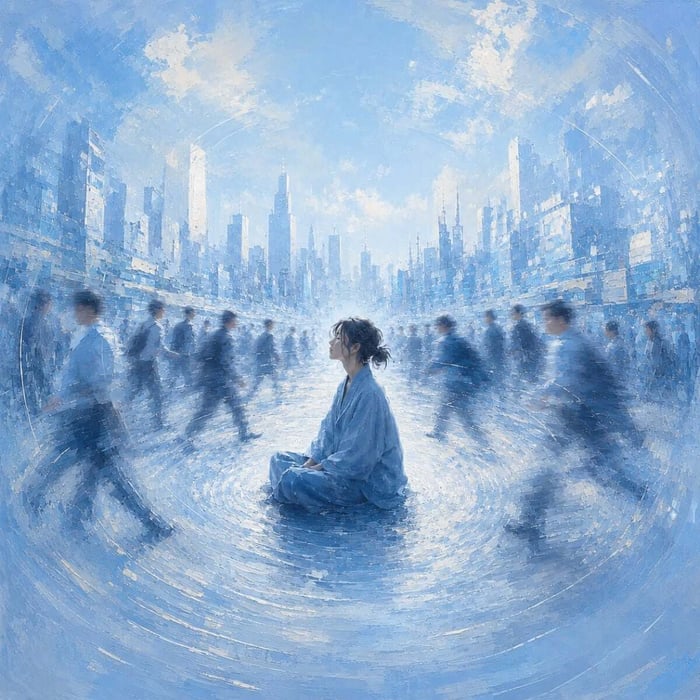
There is a particular quality to the sense of urgency in the Asia-Pacific context. Across the region — from the hyper-connected pace of Seoul and Singapore to the structured intensity of Tokyo, the relentless ambition of Sydney's financial district, or the layered complexity of life in Mumbai and Hong Kong — productivity is not just expected, it is often treated as a measure of worth. To slow down is sometimes read as falling behind. To pause is to risk being overtaken. This collective current runs deep, and many of us have internalised it so thoroughly that we no longer recognise the sense of urgency as a state we have entered. It simply feels like reality. But the body tells a different story — tension in the shoulders, shallow breath, and the persistent feeling that however much is accomplished, the list only grows.
How Chronic Urgency Distorts Your Perception of Time
Modern neuroscience confirms what contemplative traditions across Asia have long understood: our sense of time is not a fixed, mechanical tick of the clock. It is a construction of the mind, shaped moment to moment by the quality of our attention. A recent study published in Scientific American found that the brain literally dilates time when it encounters something that captures genuine, open attention — not because the clock slows, but because the mind expands its capacity to take in more. Depth of attention does not just change how we remember an experience. It changes how we live it. And it runs in the opposite direction from the contracted, tunnel-vision state that a constant sense of urgency produces. Read more about what the science shows here.
What does the sense of urgency actually do to our perception? When we move through the day in a state of constant pressure — answering before we have fully listened, moving before we have fully arrived — we narrow our perceptual field to a tunnel. Only what is immediately required reaches us. We process less, feel more reactive, and the hours collapse into a blur of activity that, paradoxically, leaves us feeling like we have not done enough. This is not a personal failing or a lack of discipline. It is how the nervous system responds when the signal of danger never fully quiets. A persistent sense of urgency keeps the brain in a mode designed for short-term survival, not for the kind of open, receptive awareness that allows life — and time — to breathe.
Urgency Is Not the Same as Engagement
We have also learned to mistake the sense of urgency for genuine engagement. The feeling of being busy — a full calendar, a buzzing phone, a list that never ends — can masquerade as being present, but these are fundamentally different states. Busyness is a form of scatter: the attention is distributed across a hundred things at once, none of them fully received. Genuine presence is the opposite — a quality of collected attention that can rest, fully, on whatever is in front of you. When the sense of urgency is running the show, the moment contracts. Presence opens it.
You may recognise the signs that urgency has replaced presence:
- The mind races ahead of the current task
- Conversations are answered before they are fully heard
- Rest feels like falling behind
- Time seems to compress, never expand
- Accomplishment brings relief, but not satisfaction
- There is always a sense that something has been left undone
Awareness Changes the Equation
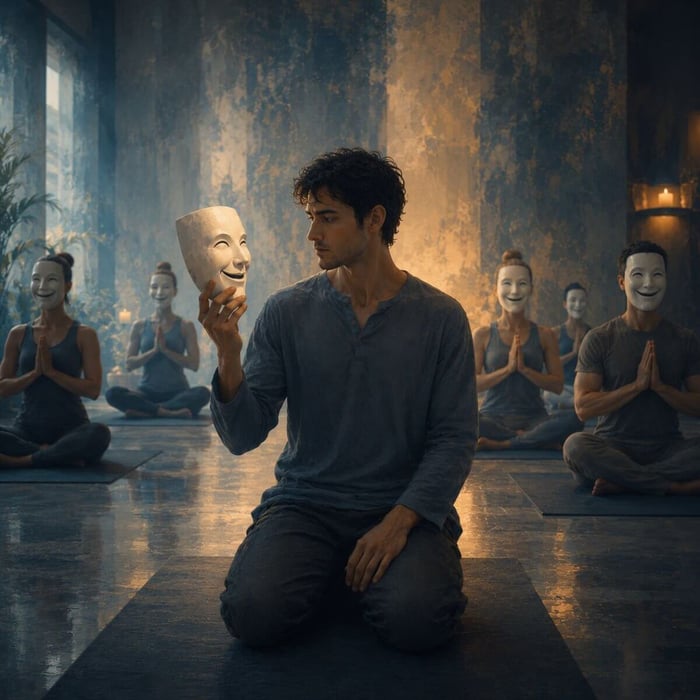
Awareness changes the equation. Not by slowing your schedule or adding yet another practice to an already full day, but by shifting the quality of your attention within the life you already have. When you are genuinely present — not managing or anticipating, but actually inhabiting the moment in front of you — the nervous system settles. The field of perception opens. The sense of urgency that once felt constant begins, almost imperceptibly, to lose its grip. This is not metaphor. It is a measurable shift in how the brain processes experience, and it is available in any moment — in the space between two breaths, in the pause before answering, in the quality of attention you bring to a single cup of tea.
Presence is often described as if it were a rare or advanced state — something achieved only after years of dedicated practice. But those who have experienced it know it as something far simpler: a sudden softening of the forward lean, a moment where the next thing loses its grip and this thing — just this — becomes enough. The sense of urgency does not always disappear in those moments, but it stops being the organising principle of your experience. Time does not vanish. It deepens. The same minute holds more — more colour, more texture, more of the actual life that is happening inside it.
What Reconnective Healing Reveals About Time
This is precisely what those who work with Reconnective Healing often describe: an unexpected spaciousness. Not because their circumstances changed, but because something in their relationship to the sense of urgency did. In a distance session — where the work takes place remotely and the recipient simply rests in a state of open, unhurried reception — many report that what felt like minutes was actually an hour, while others describe a quality of stillness that lingered for days afterward. The sense of urgency that had felt inescapable does not need to be fought or resolved. It simply becomes less defining. Space returns, and with space comes the kind of clarity that does not depend on having fewer tasks, but on bringing a different quality of mind to the ones you have. If you are curious about what it feels like to step out of urgency without going anywhere, Reconnective Healing Distance Sessions offer an accessible entry point.
The Invitation
The invitation here is not to abandon ambition or step back from the demands of your life. It is to recognise that the quality of awareness you bring to any moment directly shapes how that moment feels — and how effectively you move through it. When you release the sense of urgency as your default mode, something remarkable tends to happen: you do not just feel like you have more time. You find that you do. The same hours hold more. The same work carries less weight. The same day, met with an open rather than a contracted mind, becomes something you can actually inhabit rather than something you are constantly trying to outrun.
For a gentle way to begin exploring this shift, Dr. Eric Pearl's Presence Meditations are a natural starting point — simple, accessible, and designed not to add to your load but to return you to the spaciousness that is already present beneath the noise. You do not need experience with meditation or any particular belief system. You only need a few minutes and a willingness to let the forward momentum, just for now, soften. The space you have been looking for has not gone anywhere. It is waiting in the moment you finally stop rushing past it.
FAQs
Why do I feel so urgent inside even when nothing is actually wrong?
This is one of the most important questions to sit with — and one of the kindest things you can ask yourself. The nervous system does not always distinguish between a genuine emergency and a busy Tuesday. Over time, environments that reward constant output can condition the body to stay in a low-level state of alert, even during moments of quiet. The urgency you feel may not be a response to your actual circumstances. It may simply be a pattern the nervous system has learned. Recognising that distinction is often the first relief.
I've tried meditation before and I can't slow my mind down. Will awareness even work for me?
This is incredibly common, especially among high-achieving people who care deeply about what they do. The encouraging truth is that what's described here — and what Reconnective Healing works with — isn't about forcing the mind to be quiet. It's about shifting the quality of attention, not reducing the number of thoughts. Many people who have found traditional meditation frustrating discover that Reconnective Healing feels entirely different: less effortful, more like a recognition of something that was already there. You don't have to be still to begin.
Can awareness actually change something as physical as how I experience time?
The science says yes — and it's more direct than most people expect. Researchers have found that the brain's perception of time literally expands when attention deepens. The same moment holds more when the mind is genuinely present rather than scattered across what's next. This isn't something you need to believe in advance. It tends to be something people notice in the experience itself — a quality of spaciousness that arrives quietly, often when they weren't trying to find it.
I live in a city where urgency is just the culture. Is it realistic to actually feel differently?
Completely understandable — and yes, it is. The shift described in this article isn't about removing yourself from your environment or stepping away from ambition. It's about changing your relationship to the pace you're already living. Many people working in big cities describe a change not in their external circumstances, but in how those circumstances feel from the inside. The speed doesn't necessarily change. The grip of it does. And that difference turns out to matter enormously.
Where do I begin if I want to explore this for myself?
The most honest answer is: wherever feels easiest. That might be a few minutes of genuinely unhurried attention — not watching your breath in any particular way, not trying to achieve stillness, simply allowing what's already here to be noticed. Dr. Eric Pearl's Presence Meditations are a warm and accessible starting point for exactly this. And if you're ready to go a little deeper, a Reconnective Healing Distance Session offers a direct experience of spaciousness — no technique required, no prior experience needed. Just you, arriving fully, perhaps for the first time in a while.